
What Is Melatonin And How Does It Work? A Complete Guide
 |
Key Takeaways
- Melatonin is a hormone, not a sedative.
- Does not influence the depth of sleep.
- Secreted by the pineal gland in response to darkness.
- Blue light reduces natural production.
- Supplements mimic natural production — they don’t force sleep.
You shut your laptop, turn down the lights, and in an hour, your eyes are drowsy, and your body is ready to relax. Nothing dramatic happened. No pill. No ritual. Only darkness and a hormone to do precisely what it’s intended to accomplish.
Melatonin is that hormone, but most people have a completely wrong idea about it.
Melatonin is not a sleep-inducing medicine, nor is it a sedative. It is a signal – one your brain gives each evening that night has come, and it is time to sleep. Once you get this signal right, then sleep comes easily. Disturb it, and even eight hours in bed leaves you feeling like you got four.
In this blog, you will learn what melatonin is, how your body produces it, what causes it to become imbalanced, and how to use sleep supplements to balance your melatonin levels and get a better night’s sleep.
Table of Contents
- What Is Melatonin?
- How Does Melatonin Work in the Body?
- What Is the Pineal Gland’s Role in Melatonin Production?
- What Triggers Melatonin Release?
- What Is the Difference Between Natural and Supplemental Melatonin?
- How Long Does It Take for Melatonin to Work?
- Melatonin vs Sleeping Pills: What’s the Difference?
- Schlussfolgerung
- FAQs
What Is Melatonin?
If you’ve ever felt that wave of drowsiness roll in around the same time each evening, melatonin is largely behind it.
But what is melatonin?
Melatonin is a hormone, or more precisely, a neurohormone, produced by the pineal gland, a small pea-sized gland located in the middle of the brain. It’s not to put you to sleep. Rather, it is a biological cue that signals your body that it is getting dark and it’s time to sleep. Instead of a sleeping pill, consider it more as an alarm clock that tells you it’s now time to unwind.
Melatonin is chemically related to serotonin, which is produced from the amino acid tryptophan, which is present in food such as turkey, eggs and nuts. The biochemical reaction in your body that converts tryptophan into serotonin and then into melatonin almost exclusively happens at night.
So, when people ask,” What is melatonin?”, the short answer is this: It is your body’s darkness hormone. It does not cause drowsiness. It gets you ready for it.
How Does Melatonin Work in the Body?
You might wonder, “How does melatonin work?”
Melatonin activates two types of receptors when it enters the bloodstream: MT1 and MT2, located in the suprachiasmatic nucleus (SCN) of the brain, the body’s main biological clock. Melatonin works through these receptors to help control your sleep-wake cycle, but not the quality or depth of sleep.
Let’s take a look at what happens on a typical day:
- Morning: Light enters the eyes and suppresses melatonin production. Cortisol rises. You feel alert.
- Afternoon: Melatonin stays low, and energy levels are highest.
- Evening (most adults: 9-10 pm): Light becomes less, and melatonin increases. The body’s internal temperature decreases. You become drowsy.
- 2 to 4 am: Melatonin is at its highest levels.
- Morning again: Signals from light tell the brain to cease producing. The cycle repeats.
This rhythm is part of what scientists call the circadian rhythm — your internal 24-hour biological clock. Melatonin is one of its most important chemical messengers. In the Journal of Pineal Research, the authors report that melatonin is a ‘time-giver’ that helps synchronise not only the master clock in the brain but also secondary clocks in the liver, pancreas, and other organs.
If this system functions well, sleep comes easily. Any disruption, whether due to shift work, jet lag or late-night screen time, affects your entire physiology.
What Is the Pineal Gland’s Role in Melatonin Production?
The pineal gland is very tiny — the size of a grain of rice — and has a surprisingly large effect on sleep. It is in the middle of the brain, outside the blood-brain barrier, and observes light signals sent across the retina.
When your eyes detect darkness, the signal travels along the retinohypothalamic tract to the SCN, which then stimulates the pineal gland to produce melatonin. This conversion process involves serotonin as its substrate, which is converted to melatonin by two key enzymes: arylalkylamine N-acetyltransferase (AANAT) and acetylserotonin O-methyltransferase (ASMT).
The pineal gland is really a light meter in the body. When the light is gone, it produces melatonin, not because you are tired.
An important aspect to keep in mind is that melatonin hormone levels naturally decrease with age. Research indicates that production begins to decline around age 40, and by the 70s, the pineal gland produces much less than during young adulthood. This is one reason many older adults struggle to fall asleep.
What Triggers Melatonin Release?
Darkness is the greatest stimulus for releasing melatonin. Specifically, it is the lack of light in the short-wavelength blue region of the spectrum.
The eyes have special cells known as intrinsically photosensitive retinal ganglion cells (ipRGCs) filled with a photopigment called melanopsin. These cells are especially sensitive to blue light (of wavelengths around 460-480 nanometres). When these cells receive blue light, they send an inhibitory signal to the pineal gland, telling it not to produce melatonin yet.
According to a study published in the Journal of Frontiers in Neurology, general exposure to short-wavelength blue light from electronic screens suppresses melatonin secretion and delays sleep onset.
In an experiment at Harvard University, blue light suppressed melatonin for approximately twice as long as green light of comparable brightness, shifting circadian rhythms by around three hours.
In actual practice, social media scrolling at 11 pm is not only stimulating the brain’s thinking, but it’s making your body think the sun didn’t set.
Other factors that suppress melatonin include:
- Bright overhead lighting in the evening
- Irregular sleep schedules
- Some medicines (such as some beta-blockers and NSAIDs)
- Alcohol consumption
- Travel to different time zones and shift work (alternate shifts)
Factors that support healthy melatonin production:
- Consistent sleep and wake times
- Dim, warm lighting in the evening
- Darkness in the bedroom during sleep
- Avoiding screens for at least 60–90 minutes before bed
What Is the Difference Between Natural vs Supplemental Melatonin?
Natural melatonin is the hormone your body makes itself, a tightly regulated hormone process that is associated with light and your body’s clock. Melatonin is also available as a supplemental ingredient, a chemical replica of the compound, taken orally to supplement or balance the production of natural melatonin.
The key difference isn't what they are; it’s when and why you use them.
Melatonin is naturally made by your body on its own schedule, usually in the hours leading up to your usual bedtime. However, you can use supplements when natural production is interrupted or insufficient, such as with jet lag, shift work, delayed sleep phase syndrome, or ageing.
Most importantly, supplemental melatonin won’t make you sleepy! It is not a replacement for your existing circadian system, but rather one that can work with it. Taking a low dose at the right time (usually about 30 to 60 minutes before bedtime) helps to synchronise the body clock. Too large a dose or at the wrong time can alter your rhythm in an undesirable way.
Vitasunn melatonin is available in various dosage strengths and forms (1mg to 10mg), allowing you to select the optimum option for your needs. For those who are just starting to use melatonin or experiencing mild sleep disruption, it may be better to start with a lower dose. For guidance on choosing the right amount, our melatonin dosage guide covers the evidence in detail.

How Long Does It Take for Melatonin to Work?
The peak blood level of standard melatonin supplements is usually reached in 30-60 minutes. That’s why timing matters as much as dosage; if you take the supplement just before bedtime, it may increase as your head hits the pillow!
Generally, sleep researchers recommend taking melatonin 30 to 60 minutes before the time you wish to sleep. Some guidelines recommend starting the protocol up to 2 hours before the target bedtime to shift the circadian clock more effectively for people suffering from jet lag and/or wanting to phase-shift their sleep schedule earlier.
Timed-release formats are different. They provide a slow release of melatonin over several hours, more closely resembling how melatonin is produced overnight. Vitasunn’s Timed Release 3mg is created with this in mind and is a convenient alternative for individuals who don’t struggle to fall asleep, but may get out of bed too early or have trouble staying asleep.
The key thing to remember is that melatonin is not a knock-out drug. You won’t experience a sudden change in how you feel. What you’ll notice is that, when it’s used properly, falling asleep is more natural; it’s not forced.
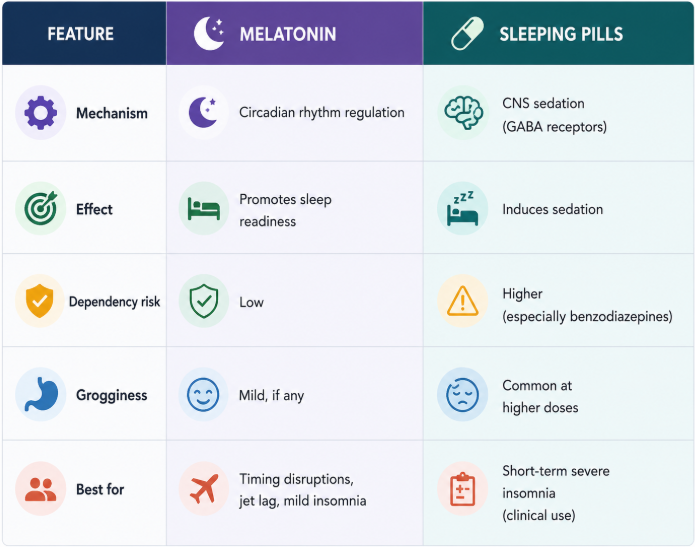
Melatonin vs Sleeping Pills: What’s the Difference?
One of the most common questions people have is which they should use: melatonin vs sleeping pills, and the distinction is significant.
The majority of over-the-counter sleep medications (such as the benzodiazepines and Z-drugs, like zolpidem) act on the GABA receptors in the brain, which have a sedative effect that essentially turns down the central nervous system activity. They can induce sleep fairly quickly. Still, they have drawbacks as well: dependency, grogginess the next day, rebound insomnia, and sleep that may be structurally different from natural sleep.
Melatonin is a completely different mechanism. It acts on the body’s own circadian receptor system (MT1 and MT2 receptors) and facilitates the action of your body’s clock, not disrupts it. It doesn’t sedate; it synchronises.
Here’s a quick comparison:
If you’re currently taking prescription sleep medication and considering melatonin, it’s worth speaking to a healthcare professional first. For more on safety considerations, our article on whether it’s safe to take melatonin every night clearly covers the research.
 |
Supporting Better Sleep
One of your body’s most basic biological signals is the melatonin hormone, which signals to your internal clock that it’s time to fall asleep. It does not cause sleepiness, but only sets up the circumstances for it.
To make the best use of melatonin, it is important to understand how it functions—timing and dosage matter. Light exposure in the hours before bed also matters. And increasingly, research suggests that protecting your natural melatonin production — by reducing screen use in the evenings and keeping a consistent sleep schedule — is just as important as any supplement.
When supplementation makes sense, Vitasunn’s range of melatonin products (1mg through to 10mg, in both standard and timed-release formats) allows you to select your preferred format.
Check out the full range, and choose the one that suits you.
Frequently Asked Questions
Q1: What exactly is melatonin?
A hormone secreted by the pineal gland, signalling darkness, and making one ready for sleep — not a sedative.
Q2: Is melatonin a sleeping pill?
No, melatonin does not work like sleeping pills, but it helps synchronise the body’s natural cycle to induce a more natural sleep.
Q3: How does melatonin make you feel?
Moderate sleepiness and decreased alertness — not full sleepiness. Ideal time of use is 30–60 min before sleep.
Q4: What is the difference between melatonin and sleeping tablets?
Sleeping medications act on the GABA receptors; melatonin acts on the circadian rhythm receptors.
Q5: Does your body stop producing melatonin if you take supplements?
Occasional supplementation doesn’t significantly suppress natural production; long-term high-dose use warrants caution.
Q6: At what age does melatonin production decline?
Natural production begins to decline around age 40, contributing to age-related sleep difficulties.
Q7: Can you take melatonin during the day?
Not recommended — it can shift circadian rhythm in the wrong direction and cause daytime grogginess.
Q8: Does light really suppress melatonin?
Yes. Blue light from screens can suppress melatonin release by up to 50%.
Beigetragen im Dezember 2022 von Alex Harpy von Schlaftest
Melatonin ist ein körpereigenes Hormon, das an der Regulierung des Schlafs beteiligt ist. Es wird oft als "Schlafhormon" bezeichnet, weil sein Spiegel im Körper nachts ansteigt und dem Körper signalisiert, dass es Zeit zum Schlafen ist.
Melatonin ist in den Vereinigten Staaten rezeptfrei als Nahrungsergänzungsmittel erhältlich, aber es ist wichtig, vor der Einnahme mit einem Arzt zu sprechen. Die richtige Dosierung von Melatonin kann je nach Alter, Gewicht und anderen Faktoren variieren, und ein Arzt kann helfen, die richtige Menge für eine Person zu bestimmen. Wenn Sie in Europa leben, kann Vitasunn Melatonin innerhalb der EU verschicken und liefern, wo es schwer zu finden ist. Melatonin wird häufig bei Schlafstörungen verschrieben, bei denen sowohl die Quantität als auch die Qualität des Schlafs beeinträchtigt ist.
Häufige Schlafstörungen
Schlaflosigkeit (Insomnie): Schlaflosigkeit ist die häufigste Schlafstörung und zeichnet sich durch Schwierigkeiten beim Einschlafen oder Durchschlafen oder durch ein unausgeschlafenes Gefühl beim Aufwachen aus. Schlaflosigkeit kann durch eine Vielzahl von Faktoren verursacht werden, darunter Stress, Angstzustände, Depressionen und bestimmte Medikamente.
Schlafapnoe: Schlafapnoe ist eine Erkrankung, bei der die Atmung während des Schlafs wiederholt unterbrochen wird, was dazu führt, dass die Betroffenen nachts häufig aufwachen. Dies kann zu übermäßiger Tagesmüdigkeit und anderen gesundheitlichen Problemen führen.
Narkolepsie: Narkolepsie ist eine neurologische Störung, die die Kontrolle von Schlaf und Wachsein beeinträchtigt. Menschen mit Narkolepsie leiden unter übermäßiger Tagesmüdigkeit und können tagsüber plötzliche, unwiderstehliche Schlafattacken haben.
Die Behandlung von Schlafstörungen hängt von der Art und dem Schweregrad der Störung ab. Sie kann Änderungen des Lebensstils, wie die Verbesserung der Schlafhygiene, oder den Einsatz von Medikamenten oder anderen Therapien umfassen. Für eine genaue Diagnose und eine angemessene Behandlung ist es wichtig, mit einem Gesundheitsdienstleister zu sprechen.
Melatonin-Ergänzungen
Melatonin-Nahrungsergänzungsmittel gibt es in verschiedenen Formen, darunter Tabletten, Kapseln und Flüssigkeiten. Einige gängige Arten von Melatoninpräparaten sind:
Melatonin mit sofortiger Wirkstofffreisetzung: Diese Art von Melatonin-Ergänzungspräparat ist so konzipiert, dass es schnell vom Körper aufgenommen wird und somit rasch seine Wirkung entfalten kann. Es wird häufig zur Behandlung von Jetlag oder zur Unterstützung des Einschlafens verwendet.
Melatonin mit verlängerter Wirkstofffreisetzung: Diese Art von Melatonin-Ergänzung ist so konzipiert, dass es über einen längeren Zeitraum allmählich freigesetzt wird, was eine nachhaltigere Wirkung ermöglicht. Es wird häufig zur Behandlung von Schlaflosigkeit und anderen chronischen Schlafstörungen eingesetzt.
Melatonin mit zusätzlichen Inhaltsstoffen: Einige Melatoninpräparate enthalten zusätzliche Inhaltsstoffe, wie Kräuter oder andere Verbindungen, die den Schlaf oder die Entspannung fördern können. Einige Melatoninpräparate können beispielsweise Baldrianwurzel oder GABA (Gamma-Aminobuttersäure) enthalten, um ihre Wirkung zu verstärken.
Es ist wichtig zu beachten, dass die Wirksamkeit und Sicherheit von Melatoninpräparaten je nach Art und Qualität des Produkts variieren kann. Es ist immer am besten, mit einem Gesundheitsdienstleister zu sprechen, bevor Sie ein Nahrungsergänzungsmittel, einschließlich Melatonin, einnehmen.
Können Melatonin-Präparate bei Schlafapnoe helfen?
Es gibt Hinweise darauf, dass Melatonin bei der Behandlung von Schlafapnoe wirksam sein kann. In einer Studie, die von der Universität von Kalifornien, San Diegofanden Forscher heraus, dass Melatonin bei Patienten mit Schlafapnoe die Schlafeffizienz verbesserte, die Zahl der Wachphasen verringerte und die Dauer des Tiefschlafs verlängerte.
Eine weitere Studie, die in der Zeitschrift Zeitschrift für klinische Medizin veröffentlicht wurde, belegt die mäßige Wirksamkeit von Melatonin und einem Melatoninrezeptor-Agonisten (Ramelteon) bei der Verlängerung der Gesamtschlafdauer und der Verkürzung der Schlaflatenz. Die Forscher fanden außerdem heraus, dass Melatonin eine positive Wirkung auf das Nervensystem hat, das an der Regulierung der Atmung während des Schlafs beteiligt ist.
Neben seinem potenziellen Nutzen bei Schlafapnoe hat Melatonin nachweislich auch andere positive Auswirkungen auf den Schlaf. Es kann dazu beitragen, die Zeit bis zum Einschlafen zu verkürzen, die Schlafqualität zu verbessern und die Symptome von Jetlag zu verringern.
Andere Behandlungen für Schlafapnoe
Melatonin kann zwar bei der Behandlung von Schlafapnoe wirksam sein, ist aber kein Allheilmittel. In manchen Fällen sind andere Behandlungen wie kontinuierlicher positiver Atemwegsdruck (CPAP), bei der Luft durch eine Maske zugeführt wird, um die Atemwege während des Schlafs offen zu halten. Weitere Behandlungsmöglichkeiten sind Gewichtsabnahme, Änderung des Lebensstils und chirurgische Eingriffe zur Entfernung überschüssigen Gewebes aus den Atemwegen.
Auch eine Gewichtsabnahme kann eine wirksame Behandlung der Schlafapnoe sein, da Übergewicht zu einer Verengung der Atemwege beitragen kann. Eine Gewichtsabnahme kann dazu beitragen, den Schweregrad der Schlafapnoe zu verringern und die Schlafqualität zu verbessern.
Auch Änderungen des Lebensstils, wie der Verzicht auf Alkohol und das Schlafen auf der Seite, können dazu beitragen, die Symptome der Schlafapnoe zu lindern. Insbesondere der Verzicht auf Alkohol kann hilfreich sein, da er die Muskeln im Rachen entspannen kann.
In einigen Fällen kann ein chirurgischer Eingriff zur Behandlung der Schlafapnoe erforderlich sein. Verfahren wie die Uvulopalatopharyngoplastik (UPPP) und die laserunterstützte Uvulopalatoplastik (LAUP) können dazu beitragen, überschüssiges Gewebe aus den Atemwegen zu entfernen und die Atmung im Schlaf zu verbessern.
Es ist wichtig, einen Arzt aufzusuchen, um eine angemessene Diagnose und einen Behandlungsplan für Schlafapnoe zu erhalten. Unbehandelte Schlafapnoe kann zu ernsthaften Gesundheitsproblemen und einer verminderten Lebensqualität führen. Ein guter Schlaf ist wichtig für die allgemeine Gesundheit und das Wohlbefinden.